The hoof wall is the weight bearing structure of the hoof and it is composed of thousands of tiny hollow fibers called tubules. These tubules run
vertically from the coronary band and are cemented together with a protein substance called keratin(see figure one). Layer upon layer of these tubules act effectively as springs to absorb tremendous amounts of concussive force while retaining the necessary tensile strength. The elasticity of these tubules and the hoof wall in general is dependent on its internal moisture content. This moisture is not simply water, but a mix of salts and electrolytes much like that found in an I.V. solution. Without this essential moisture, the hoof wall would dry up, crack, become brittle and generally fail at its job of a leaf spring/shock absorber. Too much moisture, on the other hand, can make a hoof too soft, mushy and fail to absorb its concussive load. We now understand that the ideal hoof conditioner maintains the natural moisture balance found within the hoof wall.
Where does this important moisture come from? The hoof is designed to receive at least 90 percent of its moisture from within, from the blood and lymph vessels, and a small percentage from the sole. Modern bonded sealants are so effective because they stop the evaporation of this essential moisture from escaping the hoof wall. Attempting to moisturize the hoof wall with grease or salve is mostly futile because the hoof wall is virtually non-absorbent. This is why using hoof conditioners and dressings that contain vitamins or proteins are a complete waste of time. To be of any benefit, proteins and vitamins have to pass through the digestive system and be broken down into useful building blocks by digestive enzymes. Putting vitamins and protein on the hoof wall makes as much sense as trying to eat by sticking your hand in a bowl of soup. The coronary band is the only place where products meant to condition or increase hoof growth should be applied, and even care should be taken here. This is where, along with the sole, transpiration or “breathing” occurs (see figure 2).

Figure 2
You may ask, “Why don’t wild horses have all of these hoof problems? Why do I need hoof protection if I don’t have any hoof problems now?” Good questions whose answers lie in domestication of the horse. The periople is the protective covering that evolved to contain natural body fluids within the hoof wall while repelling harmful contaminants. Thus the hoof actually has its own natural, delicate hoof sealant. This natural sealant serves wild horses well, but it is usually lost in a domestic environment. It is inadvertently removed during the shoeing process when the hoof is trimmed, balanced, leveled and shod. To compound the problem further, the domestic horse can no longer roam free over miles of open space but is confined to smaller pastures, paddocks, and stalls. Now, with little or no natural sealant left and with the horn tubules opened from nail holes and rasping, hooves are exposed to higher concentrations of destructive uric acid and other contaminants. With the protective outer covering removed, the introduction of these agents into the hoof wall can lead to breakdown of its protein, keratin. It is important to remember that because the hoof is protein, it is potentially biodegradable. Domesticated horses need a hoof conditioner that effectively replaces the periople.
Grandpa’s Hoof Conditioner.
Your grandfather and his grandfather before him intuitively used a type of hoof conditioner called pine tar. This product acted as a precursor to the modern sealants as it helped to retain moisture in the hoof wall. Pine tar, unfortunately, had its drawbacks, but Grandpa was on the right track. Later came various products that contained vegetable oil, animal fat, and petroleum-based ingredients that were used with limited success to coat the hoof and fill in the nail holes. These dressings are usually sticky, and as such, attract contaminants instead of repelling them. They tend to breakdown quickly when exposed to the environment.
Their applications actually may be counter-productive because they can serve as a bacterial and/or fungal growth medium when they fester in a small crack or nail hole. These organisms produce enzymes and exotoxins that can break down collagen and protein in the hoof wall. If you do not get hoof wall disease, the least that can happen is that the hoof can get soft and punky at the nail holes. If this happens, your horse will throw more than his fair share of shoes. The ideal hoof conditioner should be stable when cured, able to seal out harmful contaminants and resistant abrasion. Other added ingredients found in some hoof conditioners, formaldehyde and acetone, are powerful drying agents and can be downright harmful to horses, humans and the environment. Their use has been associated with cancer and liver damage. Use them with caution, or better yet, not at all. Further, these sealants or dressings do not have any resistance to abrasion and can be easily wiped off. As a result, they need to be reapplied frequently, even daily, to get the maximum benefit. The new generation of hoof conditioners is a spin-off from the field of dentistry. For years, dentists have been coating children’s teeth with bonded sealants to keep them protected against tooth decay. When someone had the idea to try this same technique and apply it to horses hooves, the new generation of bonded hoof coatings was born. These bonded coatings far outperformed the old oils and pine tars and are extremely effective at sealing in the essential moisture and sealing out the harmful substances.
New ranking system helps you make an informed decision!
Hoof dressings and conditioners can be ranked in three distinct classes – CLASS 1, 2, or 3. The ranking is determined by considering a product’s useful life and performance of the know ingredients. The selection process is non- scientific and based on published data and the observations of the authors. The function of a hoof conditioner is to improve the hoof condition by sealing moisture in the hoof (by way of the blood supply) and to repel external contaminates. Some products work better than others, and do not require reapplication as often.
Some products are known as cosmetic coatings. Their main function is to provide a shine that improves the hoof’s appearance. These coatings are sometimes called a ” hoof polish” or “hoof dressing”. In the above ranking system, cosmetic coatings, hoof polish and hoof dressings are grouped as Class 1 hoof conditioners.
Class 1 Hoof Conditioners. Class 1 hoof conditioners are most effective when applied daily. The majority of them are organic compounds that come from fats of
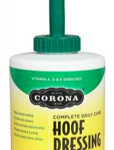
many different sources. Some have fancy names. Animal fats are classified as lanolin, emu oil, fish oil, neat foot oil, beeswax; and fats from plants (vegetable oil) include tea tree oil, aloe vera, pine tar, caster oil, linseed oil, cottonseed oil, wheat germ oil, peppermint oil, jojoba oil, etc. Like your next shower, these fats tend to wash off very quickly. They must be reapplied frequently. Some fats remain tacky and can attract contaminates. Fats offer little protection from abrasion and do not seal cracks and nail holes very well.
It is important to remember that all products that moisturize the hoof, hair, and skin work by sealing in the internal moisture, not by adding moisture from the outside or from the product itself. 
Class 2 Hoof Conditioners. Class 2 hoof conditioners are longer lasting than Class 1 Hoof Conditioners and only need to be applied twice a week to be effective. Class 2 hoof conditioners may be hybrids that contain both organic and inorganic (synthetic) components. The reason they tend to last longer than Class 1 products is that the coatings dry hard (cure) on the horn’s surface. The protection builds up with continued use and doesn’t wash away as abruptly as a fat. Collagen protein emulsions and carnauba emulsions dry hard 9cure) and are used in Class 2 hoof conditioners.
Class 3 Hoof Conditioners. These are the longest lasting hoof conditioners and only need to be applied once a week

to be effective. These products are inorganic (synthetic) and are known as polymeric compounds. They can last one to two weeks per application. Some polymeric compounds contain a very high solids content, which is what you’re paying for. The solids are what dries and is left behind to do the work. Some brands are also loaded with millions of micro-fibers that web-seal cracks and nail holes. Inorganic (inert) compounds are also resistant to moisture and uric-acid.
Tiny openings on the hoof wall, from cracks and nail holes, are the main pathways for infection from bacteria, fungus, or other contaminants. Modern technology has given us new products that are now available. With products like these available for the horse today, even grandpa would approve!



 many different sources. Some have fancy names. Animal fats are classified as lanolin, emu oil, fish oil, neat foot oil, beeswax; and fats from plants (vegetable oil) include tea tree oil, aloe vera, pine tar, caster oil, linseed oil, cottonseed oil, wheat germ oil, peppermint oil, jojoba oil, etc. Like your next shower, these fats tend to wash off very quickly. They must be reapplied frequently. Some fats remain tacky and can attract contaminates. Fats offer little protection from abrasion and do not seal cracks and nail holes very well.
 to be effective. These products are inorganic (synthetic) and are known as polymeric compounds. They can last one to two weeks per application. Some polymeric compounds contain a very high solids content, which is what you’re paying for. The solids are what dries and is left behind to do the work. Some brands are also loaded with millions of micro-fibers that web-seal cracks and nail holes. Inorganic (inert) compounds are also resistant to moisture and uric-acid.