
After devoting over 37 years providing hoof care solutions, the Smart Plan has been is one the best recommendations from our research team.
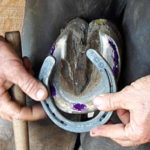 When white line disease is first identified, most horse owners expect their farrier to do a quick-fix on a suspected hoof infection as a part of their trimming and shoeing routine. The reality is that deeply rooted infections such as white line disease and chronic thrush are nearly impossible to stop with one trimming and application of a strong topical agent.
The application of a robust chemical agent usually will not stop an infection early enough. Repeated use of these strong chemical agents can be harmful to surrounding healthy hoof tissue and slow the healing process.
Removing diseased tissue and trimming the flaps of the frog are critical first steps by the farrier. Trimming opens up the hooves to oxygen which gives a head start to the healing process. Improperly trimmed feet prevent oxygen and keep beneficial topical agents from entering the crevices where the disease usually progresses.
Why Home Remedies Have their Limitations
There are inexpensive methods for treating white line disease that can work well. The horse owner or groomer should first ensure that the feet are cleaned regularly by washing and picking & brushing with a good hoof pick and brush. In 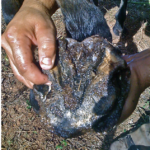 addition, most professional farriers recommend well-established commercial preparations that have been shown to be safe and effective treatments against hoof infections.
They know that home remedy recommendations, no matter how well-intended, can be dangerous and lead to permanent damage to the hoof structure if not supervised. This can lead to possible litigation if the home remedies prove damaging. Household chemicals and old home remedies recommended by the farrier do not usually carry “product liability insurance” for protecting the horse, farrier, and horse owner if results go awry.
What Causes White line Disease?
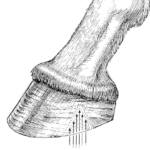 There are many variations of white line disease. The separation that occurs in white line disease is between the middle and inner layers. These gaps frequently become infected with bad bacteria and fungi.
Hoof cracks can be attributed to excessive moisture (cause feet to soften), lack of moisture (cause hard dry feet), or the frequent cycling of wet & dry conditions (wet pasture to dry stall). The bruising or trauma to the live-laminae’s inner layers can also attract the harmful bacteria and fungi, as well as through old nail holes.
Once the stratum medium is compromised, bad bacteria and fungi can invade and break down the soft tissue. The infection progresses upward, climbing from the ground surface upward to the coronary band. It forms a triangular pattern of destruction within the hoof wall that is wider at the base. The apex heads toward the coronet band. This is why removing the diseased hoof tissue by the farrier along the horn rim is a critical first step in treatment.
Chemicals Used To Treat White Line Disease
After debridement of the diseased tissue, the farrier usually medicates the affected areas with a strong chemical. Although it is tempting to use household chemical agents or strong commercial products, it is important first to know how they work.
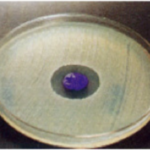 Caustic chemicals are acidic and work by basically burning pathogens to death. Disinfectants work by causing the outer walls of bacterial cells to rupture. Both chemical agents can be harmful to the cell membranes of the surrounding health hoof tissue, especially when reapplying frequently. The kill zones created by these harsh chemicals cause endospores, which result in the chronic hoof conditions that never seem to improve. These spores act like bacterial seeds that blossom and return to their original form when environmental conditions improve.
Hoof researchers from SBS Equine have developed formulas using non-prescription pharmaceutical ingredients with a proven record for safety and efficacy in treating hoof disease. These smart ingredients work by preventing fungus and bacteria from reproducing without harming surrounding health tissue.
Even if you don’t eliminate all the harmful organisms with the first application of smart ingredients, their repeated and consistent use can kill enough of them to slow the advancement of the disease to the point that it can grow out with successive trimmings. This helps halt the progression of the disease and gives healthy hoof tissue a chance to grow and prosper as nature intended.
What are Smart Formulas and How do they Work?
Smart liquid formulas are designed to penetrate tiny fissures, cracks, and nail holes. They enter the horn tubules that are open at the hair line. When the hair line is saturated with these liquids (using sprayers or daubers), they can travel down the tiny straw-like tubules to the affected areas, even behind wrapped or taped feet. This helps halt the progression of the disease and start the healing process.
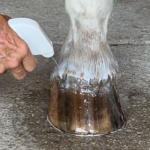 The importance of training horse groomers with this hoof care step should not be underestimated. Over 60% of horse groomers are females (many of them are very young). The safest way to get positive results against hoof infections may be using a smart liquid treatment after daily grooming, even without touching the feet.
Smart Gel formula’s enduring success has been their ability to stop deeply rooted spores in hooves. The CDC reports that deeply rooted infections contain spores. They are a major health issue because spores are so difficult to defeat. New CDC guidelines recommend that high strength disinfectants need a contact time up to 12 minutes or more to kill deeply rooted spores, which Smart Gel Formulas can provide.
Horse handlers or owners can apply the Smart Gel into gaps along the white line area, heals, voids, and cracks, with the help of their handy packaging (squeeze bottles or plastic syringes) containing long tip dispensers. Smart Gels stick to hoof tissue longer than liquid products, which improves contact time against pathogens and spores.
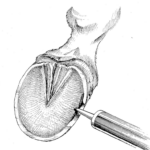 The gels are time-release formulas that allow their key ingredients to absorb into affected tissue more uniformly and over an extended time period. Smart Gel Formulas also contain a tell-tale dyes that stains the diseased tissue a purple color, and shows where to add more gel as the purple color fades.
For more articles on equine hoof care, gastric equine ulcers, and other horse related issues please check out www.sbsequine.com/articles.